As our ability to communicate through means such as texting and internet sites like Twitter and Facebook has increased, our political participation has changed as well. Many would assume that because of these new open technologies, participation in the democratic process would increase, but in-fact these sites have become detrimental and hazardous to political discourse in our country. We are no longer well informed, but have grown impressionable as technology and the advent of the 24 hour news channel grow in popularity. This growing problem has become more evident within the last year starting with the access (or lack thereof) to information during the presidential race of 2008, and the current political issue of healthcare reform. We no longer engage in dialogue on issues, but instead find it convenient to have the information filtered to us. And in many cases we never receive the information at all.
According to Thomas Hollihan’s Uncivil War: Political Campaigns in a Media Age “Public audiences are exposed to a barrage of experiences, events and messages that they must attempt to explain and understand. People acquire their political attitudes and information through these experiences and through their interactions with others. The media play a role in these events, as do conversations with friends, relatives, neighbors and colleagues.” (pg. 17) And while this has been a truth for many years, the increased access to media via social networks and 24 hour news stations has diminished our ability to effectively process and discuss the topics and issues.
Proof of this inability to filter information is evident in this screen shot from Fox News Channel. During President Obama’s address to school children on September eighth 2009, Fox, flashed this information bar below the president at eight minutes into his speech “Obama: Need Students to develop skills and intellect.” Now some may ask, what is wrong with that? To understand the issue of such a claim, one must understand where Fox sits on the political spectrum. More times than not, Fox is considered to be extremely conservative, and in many instances, the personalities on Fox have been known to call President Obama a socialist (Bill O’Reilly), and the anti-Christ (Glenn Beck). In O’Reilly’s defense he says it jokingly here, but repeatedly on his program, as throughout Fox programming, Obama is pegged to have Communist tendencies.
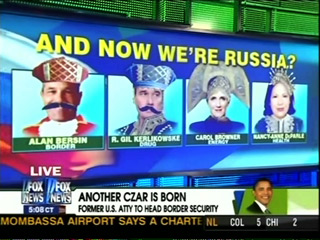
When media personalities begin to use terms and images like these to describe political heads, citizens begin to shape their opinions in what can be considered a poor light. In a specific example Fox News flashed this screen shot in light of President Obama appointing positions within his administration as watch dogs for major industry. Fox chose to label these people as Czars, making a connection to Russia, which has a long history of Communism. The interesting part of this "bite" is that a czar should be a reference to Imperial Russia, a Czar is a king, not a dictator.
This screen shot is also posted on Rush Limbaugh’s website http://www.rushlimbaugh.com/home/daily/site_090809/content/01125107.guest.html. The interesting thing to note here is the headline “Obama’s School Speech Explained.” At this point a media personality has taken it upon himself to explain the meaning and connotation behind President Obama’s Speech. This may seem like participation but it would actually take someone just as long to read Rush’s transcript as it would to hear The President’s speech first hand. So by allowing the media to filter this speech and give you “highlights” the true meaning and message of the speech is shaped how the media outlet wants it.
Another recent example of political participation, recent hot button debate has come from a comment former Alaska Governor Sarah Palin made. In a public appearance Mrs. Palin commented on HR 3200: America’s Affordable Healthcare Act of 2009, specifically remarking on “Section 1233” regarding “Advance Care Planning Consultation” as it pertains to what Palin called Death Panels. In the address obtained from Yahoo! News, Palin comments “Section 1233 authorizes advanced care planning consultations for senior citizens on Medicare every five years, and more often ‘if there is a significant change in the health condition of the individual ... or upon admission to a skilled nursing facility, a long-term care facility... or a hospice program …The America I know and love is not one in which my parents or my baby with Down syndrome will have to stand in front of Obama’s ‘death panel’ so his bureaucrats can decide, based on a subjective judgment of their ‘level of productivity in society,’ whether they are worthy of health care. Such a system is downright evil.”
This Quote created a firestorm for both parties. Putting Democrats on the defensive about the language of the document, while putting Republicans on the offensive with a new hot button term known now as “death panel.” Now by reading the whole quote, one can understand where Mrs. Palin would make the analogy of the “death panel” as it pertains to the counseling at the end of life, or need to update medical records. Unfortunately, if you read “Section 1233” it is a bit easier to understand the actual stipulation discussed.
“(F)(i) Subject to clause (ii), an explanation of orders regarding life sustaining treatment or similar orders, which shall include--
‘(I) the reasons why the development of such an order is beneficial to the individual and the individual’s family and the reasons why such an order should be updated periodically as the health of the individual changes;
‘(II) The information needed for an individual or legal surrogate to make informed decisions regarding the completion of such an order; and
‘(III) the identification of resources that an individual may use to determine the requirements of the State in which such individual resides so that the treatment wishes of that individual will be carried out if the individual is unable to communicate those wishes, including requirements regarding the designation of a surrogate decision maker (also known as a health care proxy).
‘(ii) The Secretary shall limit the requirement for explanations under clause (i) to consultations furnished in a State--
‘(I) in which all legal barriers have been addressed for enabling orders for life sustaining treatment to constitute a set of medical orders respected across all care settings; and
‘(II) That has in effect a program for orders for life sustaining treatment described in clause (iii).
‘(iii) A program for orders for life sustaining treatment for a States described in this clause is a program that--
‘(I) ensures such orders are standardized and uniquely identifiable throughout the State;
‘(II) distributes or makes accessible such orders to physicians and other health professionals that (acting within the scope of the professional’s authority under State law) may sign orders for life sustaining treatment;
‘(III) Provides training for health care professionals across the continuum of care about the goals and use of orders for life sustaining treatment; and
‘(IV) is guided by a coalition of stakeholders includes representatives from emergency medical services, emergency department physicians or nurses, state long-term care association, state medical association, state surveyors, agency responsible for senior services, state department of health, state hospital association, home health association, state bar association, and state hospice association.
Now actually looking at the document, there are no mentions of “death panel” listed anywhere in the document. In-fact, read the entire bill, and not one time does “death panel” come up. But because Sarah Palin said it in a speech, many people on conservative side of the spectrum ran with the term. This includes reporters who began to use the phrase whenever it was deemed necessary to address the stipulation. In doing so, the term completely reshaped the discourse surrounding the bill; particularly in the town hall meeting that have been taking place across the country as well in the online social networks. On Sarah Palin’s Facebook she further elaborates on her speech. And while Palin’s response seems to be warranted and substantiated in some regards, a stream of over 3 thousand responses fallowed. Some included such participation inspiring comments like “Govt. has NO RIGHT NO RIGHT ever to tell us what we may have, to have bureaucrats interfere and invade our most private of rights. This is how the Nazis started out,” brought to you by Judith Ne. Or another highly intelligible comment such as “how it got this way. I'm sure the Germans that didn't speak up at the beginning of Hitler's rule, sure wished they had when they finally realized what type of demagogue they had allowed to become leader of their country. We get the government we deserve, so let's start deserving better.”
The provision states that in the event of no living will, end of life counseling would take place. The federal government would be making no decisions on whether someone deserves to live over the other, but the bill does state that for those who are on life support who cannot make the decision for themselves, it is possible for first a family member or next of kin to decide what the best option is.
As Hollihan states in his book “We might learn more about political candidates and how they would govern if we could get candidates to talk in detail about their positions on complex issues… Instead, candidates make pithy sound-bite statements… And the public gets little in the way of real information (page 52).” As a society, we have come to rely on the sound-bites to shape our political views. A 30 second news clip on a 30 minute address holds greater value, than actually watching or reading the transcript. This creates a social environment where the use of 30 second clips as valid support for an argument is acceptable.
When the information does finally get funneled down to everyday Americans, much of the information has been presented in such a way that it is impossible to truly understand. An example from a town hall meeting in which a man approaches a woman in the crowd to get her view on the current healthcare debate demonstrates how a lack of knowledge on the issues shapes our discourse and political participation.
So many things this woman says are contradictions I don’t know where to begin. “I don’t want to identify myself with any group” when moments earlier she says she’s a Republican. She says “I believe in biblical values.” If I’m not mistaken, The Bible says something along the lines of take care of your fellow man. She also references that illegal immigrants will get health care, in HR 3200; there is not one mention of health care being provided to illegal aliens. She also mentions that no one is “obligated to give you care,” but in fact hospitals cannot turn away anyone... it’s the law. This “participant” is the perfect example of the difference between Participation and sound-bite involvement. She wants the word to spread “ten people tell ten people,” but in all reality has only a small idea of how the proposed bill would work or what it contains. She would be better served to sit down and become informed beyond the banter that is offered via media outlets and inform herself before she speaks.
Below is an interview with New York Congressman Anthony Weiner on Morning Joe with Joe Scarborough. The interview is a fantastic example of the dialogue that should be taking place in order for citizens to be informed.
Congressman Weiner articulates his opinion, and Scarborough does a good job of asking Weiner to elaborate on points. The discourse that takes place is a good example of responsible media shaping participation.
So what are the facts on health care? The numbers are staggering according to National Coalition on Health Care.
- National health spending is expected to reach $2.5 trillion in 2009, accounting for 17.6 percent of the gross domestic product (GDP). By 2018, national health care expenditures are expected to reach $4.4 trillion—more than double 2007 spending.
- National health expenditures are expected to increase faster than the growth in GDP: between 2008 and 2018, the average increase in national health expenditures is expected to be 6.2 percent per year, while the GDP is expected to increase only 4.1 percent per year.
- Over the last decade, employer-sponsored health insurance premiums have increased 119 percent.
· the average employer-sponsored premium for a family of four costs close to $13,000 a year, and the employee foots about 30 percent of this cost. Health insurance costs are the fastest growing expense for employers. Employer health insurance costs overtook profits in 2008, and the gap grows steadily.
· Total health insurance costs for employers could reach nearly $850 billion by 2019. Individual and family spending will jump considerably from $326 billion in 2009 to $550 billion in 2019.
- The Congressional Budget Office has estimated that job-based health insurance could increase 100 percent over the next decade. Employer-based family insurance costs for a family of four will reach nearly $25,000 per year by 2018 absent health care reform.
- A recent study found that 62 percent of all bankruptcies filed in 2007 were linked to medical expenses. Of those who filed for bankruptcy, nearly 80 percent had health insurance.
- According to another published article, about 1.5 million families lose their homes to foreclosure every year due to unaffordable medical costs.
- Without health care reform, small businesses will pay nearly $2.4 trillion dollars over the next ten years in health care costs for their workers, 178,000 small business jobs will be lost by 2018 as a result of health care costs, $834 billion in small business wages will be lost due to high health care costs over the next ten years, small businesses will lose $52.1 billion in profits to high health care costs and 1.6 million small business workers will suffer “job lock“— roughly one in 16 people currently insured by their employers.
These are the facts as to why health care reform is important. But I challenge any reader to identify a news organization that has devoted the time to the facts. Most of the discourse surrounded in this topic, as with many, is covered in buzz words that have no actual effect on the topic.
So next time you are listening to the so called "dialogue" that the sound-bite media has to offer, remember that only you can shape your participation in a productive manner. Ask questions and choose to seek out the information so readily available first hand, not through filters or sound-bites that are detrimental to participation. Because at the end of the day, we are the ones who the decisions and discourse effect the most.

No comments:
Post a Comment